Evaluating and Improving Symbolic Regression Methods for Biological Network Dynamics
| GSoC metadata | Details |
|---|---|
| Program | Google Summer of Code 2026 |
| Organization | National Resource for Network Biology (NRNB) |
| Contributor | Norma C Pérez Rosas |
| Mentors | Augustin Luna, Eran Agmon, Mark Kittisopikul, and Matthias König |
| Work product | PySR-BioModels benchmark |
1. Project overview
Mechanistic models in systems biology are frequently expressed as systems of ordinary differential equations (ODEs). These equations describe how interacting biological components change over time and are widely used to represent signaling networks, metabolic pathways, gene-regulatory systems, and other biochemical processes.
In conventional mechanistic modeling, researchers usually specify the mathematical form of these equations using biological knowledge and subsequently estimate their parameters from experimental data. Equation discovery considers a more general problem: whether the mathematical equations themselves can be inferred from observations of a dynamical system.
Symbolic regression is particularly interesting for this purpose because it searches for explicit mathematical expressions rather than fitting only the parameters of a predefined model. The resulting equations can provide interpretable representations of observed dynamics.
However, equation discovery also raises an important scientific question. A mathematical expression may reproduce observed trajectories without necessarily being the same equation that generated those trajectories. Predictive accuracy and recovery of the underlying mathematical mechanism therefore need to be evaluated separately.
The goal of this Google Summer of Code project was to develop a reproducible framework for investigating symbolic regression in biological dynamical systems.
The resulting work product, PySR-BioModels, combines curated biological models from BioModels with controlled simulation, symbolic regression using PySR, independent validation and held-out evaluation, and comparison with known reference equations.
The project produced an expanded benchmark containing 100 benchmark-ready biological ODE models, together with software infrastructure for executing, evaluating, auditing, and reproducing symbolic-regression experiments.
The final work provides both a PySR baseline for biological ODE equation discovery and an experimental framework that can be extended to additional methods.
2. Motivation and objectives
A deterministic biological dynamical system can be represented generally as
\[\frac{d\mathbf{x}}{dt} = \mathbf{f}(\mathbf{x},\boldsymbol{\theta}),\]where $\mathbf{x}$ represents dynamic state variables, $\boldsymbol{\theta}$ represents model parameters, and $\mathbf{f}$ describes how the biological system evolves.
In an equation-discovery problem, the objective is to infer an approximation of the governing dynamics from observations:
\[\frac{d\mathbf{x}}{dt} \approx \hat{\mathbf{f}}(\mathbf{x}).\]Symbolic regression approaches this problem by searching over mathematical expressions. Instead of selecting only parameter values, it can search over combinations of variables, mathematical operators, and constants to construct candidate equations.
PySR is an open-source symbolic-regression system designed for scientific applications [1]. Symbolic regression and related equation-discovery approaches have also been applied to dynamical systems and biological modeling [2-6]. These studies motivated the use of PySR as a practical baseline for systematic biological ODE reconstruction.
BioModels provides a useful environment for this problem because it contains curated computational models of biological processes [7]. Many of these models are represented using the Systems Biology Markup Language (SBML) [8], allowing the original mathematical model to serve as a known reference.
This makes it possible to construct controlled experiments in which the original biological model is known, synthetic observations are generated under standardized conditions, symbolic regression attempts to reconstruct the dynamics, and the resulting equations can subsequently be compared with the reference system.
The main objectives of the project were to:
- construct a reproducible benchmark from curated biological ODE models;
- generate controlled dynamical data for equation discovery;
- implement a PySR-based inference workflow;
- separate equation fitting, system selection, and final evaluation;
- evaluate predictive and mechanistic aspects of inferred equations;
- investigate the effect of providing different amounts of training information; and
- provide reproducible software and execution infrastructure for future studies.
3. Building the BioModels benchmark
A major part of the project involved transforming a heterogeneous collection of curated biological models into a consistent benchmark suitable for symbolic-regression experiments.
The project started from a local collection of curated BioModels entries. Models were screened for compatibility with the standardized simulation and inference workflow.
This required more than simply obtaining SBML files. Biological models can differ substantially in their use of species, parameters, rules, events, initial conditions, and other SBML constructs. The benchmark therefore performs model-level checks before a model enters the symbolic-regression experiment.
During development, the model-discovery procedure was improved after identifying that valid downloaded BioModels entries do not always use the same local SBML filename convention. The revised workflow performs explicit file discovery and rejects ambiguous cases instead of assuming that every model uses a single canonical filename.
These improvements expanded the set of models that could be evaluated while preserving provenance about the biological inputs.
The resulting Expanded-100 benchmark contains 100 biological models that passed the requirements for the final experiment.
Here, benchmark-ready means that a model satisfied the requirements to enter the experiment. Workflow execution and scientific evaluation are treated as separate stages.
4. Experimental workflow
The benchmark follows a controlled training, validation, and held-out evaluation design.
For each biological model, multiple initial conditions are generated by perturbing the dynamic state variables around their nominal values. These perturbations produce different trajectories through the model’s state space.
The resulting experiments are separated into three groups:
- training trajectories, used to generate candidate equations;
- validation trajectories, used to select among candidate coupled systems; and
- held-out trajectories, used only after system selection for final predictive evaluation.
Several nested training-set sizes are evaluated so that the influence of additional dynamical information can be studied while maintaining independent validation and held-out data.
The original SBML models are simulated using RoadRunner [9]. In the baseline developed during this project, the simulator also provides exact state derivatives associated with the generated trajectories.
This creates a controlled starting point for studying symbolic equation reconstruction independently from the additional problem of estimating derivatives from experimental observations.
Symbolic-regression stage
PySR is applied to the simulated data to generate candidate expressions for the rates of change of the dynamic states.
Individual state equations ultimately need to operate together as a dynamical system. The benchmark therefore goes beyond evaluating isolated symbolic expressions. Candidate equations are assembled into complete coupled ODE systems and evaluated through numerical simulation.
Validation trajectories participate in this system-selection stage.
Only after a coupled system has been selected and frozen is it evaluated on the held-out trajectories.
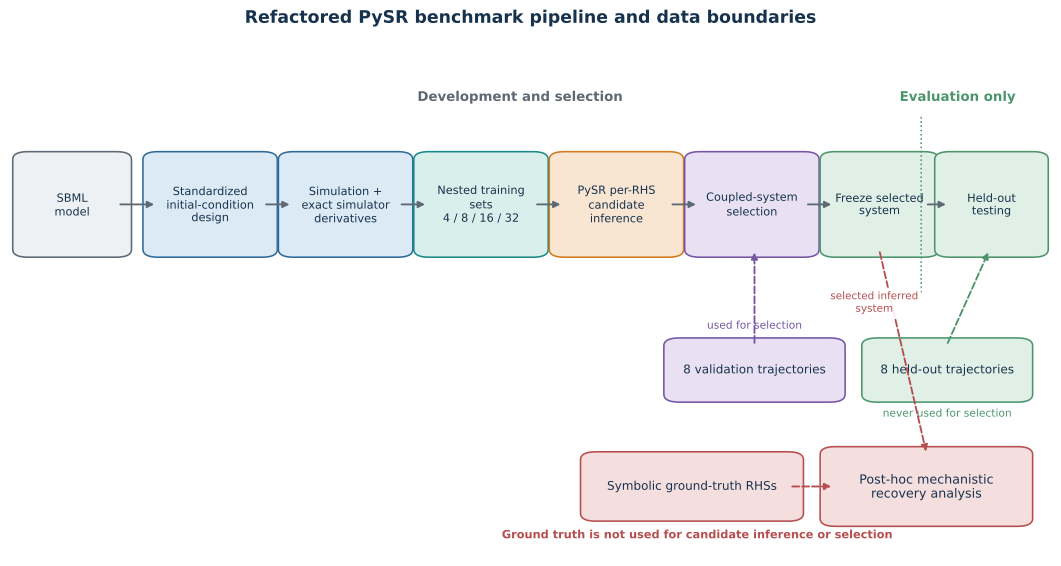
Figure 1. Overview of the PySR-BioModels workflow. Training data are used for symbolic-regression candidate generation, validation trajectories participate in coupled-system selection, and held-out trajectories are reserved for final evaluation.
The reference equations from the original biological models are kept separate from the inference and selection stages and are used afterward for mechanistic comparison.
This organization establishes a clear boundary between equation generation, model selection, predictive testing, and mechanistic analysis.
5. Evaluation framework
One of the main methodological outcomes of the project was the development of a multi-level evaluation framework.
A symbolic-regression result cannot always be described adequately by a single label such as “recovered” or “not recovered.” Several distinct questions can instead be asked.
Predictive behavior
The first question is whether an inferred coupled ODE system can reproduce dynamics that were not used during fitting or system selection.
The benchmark therefore integrates the selected system from held-out initial conditions and compares the resulting trajectories with those generated by the reference biological model.
This evaluates dynamical generalization.
Mathematical structure
A second question is whether the inferred equations recover mathematical characteristics of the reference equations.
For example, an inferred equation may identify the relevant state variables while representing their interactions differently from the original model.
The project therefore developed analyses for comparing several structural properties of inferred and reference equations rather than reducing mechanistic recovery to a single binary outcome.
Numerical and symbolic agreement
The benchmark also distinguishes approximate numerical agreement between right-hand sides from exact symbolic agreement.
Two expressions may behave very similarly over a region of state space while still being different mathematical expressions. Exact symbolic recovery represents a stronger criterion.
The resulting framework separates several levels of assessment:
workflow completion → predictive behavior → structural similarity → numerical agreement → exact symbolic agreement
These levels answer different questions and provide a more informative description of symbolic-regression performance than a single recovery metric.
6. General results
The Expanded-100 experiment demonstrated that the workflow can be applied across a heterogeneous collection of curated biological ODE models.
The experiments showed substantial variation among models in both computational difficulty and symbolic-regression behavior. Many models completed the full workflow, while others encountered computational limits or stage-specific execution failures.
The project therefore treats execution status separately from scientific evaluation. A run that is interrupted by computational constraints is not automatically classified as a failure of equation reconstruction.
The completed experiments also reinforced the importance of distinguishing predictive performance from mathematical recovery.
Inferred systems can reproduce unseen dynamics while differing from the original mathematical representation. Conversely, individual characteristics of the reference equation can sometimes be identified even when the complete governing expression is not reconstructed.
The experiments also showed that symbolic-regression behavior can depend on the amount of training information and that the effect of additional trajectories varies across biological systems.
Together, these observations support the use of multiple complementary evaluation criteria when studying symbolic equation discovery.
7. Software engineering and reproducibility
A substantial part of the GSoC work involved making the benchmark reproducible and auditable.
For a computational benchmark, reproducibility requires more than publishing the inference algorithm. It must also be possible to determine which biological models were analyzed, which experimental configuration produced a result, which computational stages completed, and which artifacts belong to the same experiment.
Provenance and manifests
Benchmark executions use run manifests to record model cohorts, experimental configuration, simulation metadata, execution status, and relevant input provenance.
The workflow also records information that helps identify changes to biological inputs rather than relying only on filenames.
These records connect aggregate analyses with the model-level computations that produced them.
Resumable execution
Symbolic-regression experiments can require substantial computation. Large benchmark runs may be interrupted by resource limits, machine restarts, or individual process failures.
The project therefore supports checkpointing and resumption so that previously completed work can be reused when its provenance remains compatible with the current experiment.
Execution failures and resource-related outcomes are recorded separately from scientific evaluation.
Held-out evaluation
The held-out boundary is implemented directly in the workflow.
Candidate generation and system selection occur before held-out evaluation. The selected system is frozen before the final test stage is performed.
This makes the separation between model development and final evaluation explicit and auditable.
Docker environment
The repository includes a Docker workflow that packages the benchmark software environment and Expanded-100 inputs.
The container provides the principal Python, Julia, PySR, simulation, and benchmark dependencies required for execution. Generated outputs are written outside the container through a host-mounted output directory.
The Docker environment reduces the amount of manual configuration required to reproduce the workflow on another compatible machine.
The current containerized workflow targets Linux amd64.
Additional instructions are provided in the repository’s Docker deployment guide.
8. Project evolution during GSoC
The original project proposal considered a broad evaluation of symbolic-regression approaches for biological network dynamics.
During GSoC, several methodological directions for equation discovery in biological dynamical systems were investigated. This work helped identify the need for a common experimental framework in which different approaches could be evaluated consistently.
As the project progressed, establishing a common experimental foundation became a central priority.
Meaningful comparisons among equation-discovery approaches require common biological inputs, controlled data partitions, explicit evaluation criteria, reproducible execution, and consistent definitions of equation recovery.
The final GSoC work therefore focused on establishing the PySR benchmark end-to-end.
The completed work includes:
- biological-model selection and auditing;
- standardized simulation;
- controlled training, validation, and held-out partitions;
- symbolic-regression candidate generation;
- coupled-system selection;
- held-out dynamical evaluation;
- mechanistic equation comparison;
- execution provenance;
- resumable computation;
- analysis infrastructure; and
- containerized execution.
This provides a complete baseline while also establishing infrastructure that can support additional equation-discovery approaches.
9. Limitations and future work
The current benchmark was designed as a controlled baseline.
An important limitation is that the primary experiments use simulated trajectories and exact derivatives from known SBML models. Experimental biological measurements generally include noise, incomplete observations, limited temporal resolution, and no direct access to exact derivatives.
A natural extension is therefore to evaluate equation discovery when derivatives must be estimated from trajectory data and when observations contain controlled noise.
Future work can also investigate sensitivity to symbolic-regression search conditions, extend the benchmark to additional classes of biological models, and study systems requiring variables or inputs beyond the current state-based representation.
Another important direction is comparison with additional equation-discovery approaches. The infrastructure developed during this project provides common biological models, data partitions, and evaluation concepts that can be used for such comparisons.
This includes continued investigation of additional approaches for discovering interpretable dynamical models.
More broadly, understanding the relationship between predictive performance and mechanistic interpretation remains an important challenge for data-driven biological modeling.
10. Work product
The principal GSoC work product is available in the public repository:
The repository contains the benchmark implementation, documentation, reproducibility infrastructure, and supporting analysis code.
Key resources include:
- Project overview and usage
- Docker build and execution guide
- Docker definition
- Bundled Expanded-100 inputs
- Experimental design implementation
- Simulation implementation
- PySR candidate generation
- Coupled-system selection
- Held-out evaluation
- Mechanistic ground-truth extraction
- Algebraic-recovery evaluation
Together, these components provide a reproducible starting point for continued work on symbolic equation discovery in biological dynamical systems.
11. Conclusions
This GSoC project developed a reproducible framework for evaluating symbolic regression on biological ODE systems with known ground truth.
The work transformed curated BioModels models into a standardized benchmark, generated controlled dynamical observations, integrated PySR into an equation-discovery workflow, implemented coupled-system selection and independent held-out testing, and developed multiple levels of comparison between inferred and reference equations.
The final Expanded-100 benchmark contains 100 benchmark-ready biological models and provides infrastructure for studying symbolic-regression behavior across heterogeneous dynamical systems.
The experiments reinforce an important methodological point: reproducing dynamical behavior and reconstructing the underlying mathematical equations are related but distinct objectives.
Equation-discovery methods should therefore be evaluated using complementary measures of predictive and mechanistic behavior rather than a single definition of recovery.
Beyond the PySR baseline itself, a major outcome of the project is the reusable experimental infrastructure. The benchmark provides controlled biological inputs, explicit data boundaries, system-level evaluation, provenance, reproducible execution, and mechanistic-comparison tools that can support continued evaluation of symbolic-regression methods for biological dynamical systems.
Acknowledgements
I thank my mentors Augustin Luna, Eran Agmon, Mark Kittisopikul, and Matthias König for their guidance throughout the project, and the National Resource for Network Biology for supporting this work.
I also acknowledge the BioModels maintainers and model contributors whose curated SBML resources make systematic benchmarking possible, as well as the developers of PySR, Julia, RoadRunner, libSBML, SciPy, SymPy, and the broader open-source scientific-computing ecosystem used by this project.
References
-
Cranmer M. Interpretable Machine Learning for Science with PySR and SymbolicRegression.jl. arXiv. 2023. arXiv:2305.01582.
-
Brunton SL, Proctor JL, Kutz JN. Discovering governing equations from data by sparse identification of nonlinear dynamical systems. Proceedings of the National Academy of Sciences. 2016;113(15):3932-3937. doi:10.1073/pnas.1517384113.
-
Ahmadi Daryakenari N, De Florio M, Shukla K, Karniadakis GE. AI-Aristotle: A physics-informed framework for systems biology gray-box identification. PLOS Computational Biology. 2024;20(3):e1011916. doi:10.1371/journal.pcbi.1011916.
-
de Rooij M, van Riel NAW, O’Donovan SD. Conditional universal differential equations capture population dynamics and interindividual variation in C-peptide production. npj Systems Biology and Applications. 2025;11:84. doi:10.1038/s41540-025-00570-6.
-
Grigorian G, George SV, Arridge S. Learning governing equations of unobserved states in dynamical systems. Physica D: Nonlinear Phenomena. 2025;472:134499. doi:10.1016/j.physd.2024.134499.
-
de Pomereu T, Fröhlich F. Symbolic regression enables coarse-grained model discovery of intracellular signalling dynamics. bioRxiv. 2026. doi:10.64898/2026.08.20.745973.
-
Malik-Sheriff RS, Glont M, Nguyen TVN, et al. BioModels—15 years of sharing computational models in life science. Nucleic Acids Research. 2020;48(D1):D407-D415. doi:10.1093/nar/gkz1055.
-
Hucka M, Bergmann FT, Dräger A, et al. The Systems Biology Markup Language (SBML): Language Specification for Level 3 Version 2 Core. Journal of Integrative Bioinformatics. 2018;15(1):20170081. doi:10.1515/jib-2017-0081.
-
Somogyi ET, Bouteiller JM, Glazier JA, et al. libRoadRunner: a high performance SBML simulation and analysis library. Bioinformatics. 2015;31(20):3315-3321. doi:10.1093/bioinformatics/btv363.